


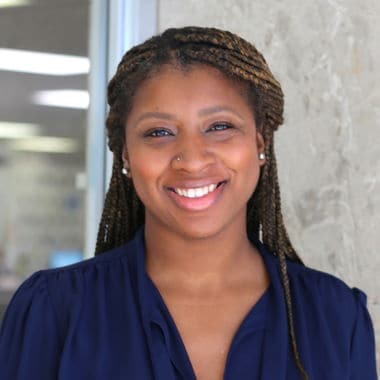
“I am incredibly inspired by women leaders of color in education and within my organization in particular. When I see them helping to shape the future of our organization with a very clear-eyed focus on students and communities, it gives me permission to also be unapologetic about who we do this work for.”
JuDonne HemingwayManaging Director of Corps Member DevelopmentTeach For America Indianapolis
This profile is part of our 2020 Women's History Month celebration. Read the main story.
What do you do in your current job? What leadership roles do you hold outside of your job?
JuDonne Hemingway is an experienced, innovative, and adaptive systems leader who helps emerging leaders persist unapologetically in pursuit of their visions. She explores how strategic analysis, responsive practices, and values-based leadership development work together to help leaders ignite their superpowers and reimagine what’s possible. JuDonne serves as principal at Gary Comer Middle School, part of Chicago's Noble Schools charter network.
Outside of the work that I do as described in my short bio above, I am a full-time mother, auntie, sister, and friend. I consider these roles as leadership roles because they require me to inspire and influence people I care deeply about so that they can pursue the things that bring them joy. While I love my work, and it matters a great deal to me and my overall identity, it is these more personal leadership roles and responsibilities that keep me going, and that keep me grounded. Being a mother and an educator has meant that in real-time, I get to think about what I would want for my own children and lead in ways that ensure that other people’s children get the best, too.
Who, or what types of female leaders, inspire you (especially within your field) to do this work?
I am incredibly inspired by women leaders of color in education and within my organization in particular. When I see them helping to shape the future of our organization with a very clear-eyed focus on students and communities, it gives me permission to also be unapologetic about who we do this work for. I have seen women of color lead across the ed space with grace, poise, and a fierce commitment to ending disparate practices that limit the amount of being and dreaming that kids of color get to do. I am grateful to TFA and other organizations in which I’ve worked and led for these very clear exemplars of leadership and the art of “becoming."
What do you think are the biggest issues that women still have to face today?
While there are many challenges, one that feels most top of mind for me right now is the extent to which women are linking arms and coming together in service of equity across the board. As a woman of color, I am fortunate to have women from other backgrounds in my corner as allies on issues like racial equity. However, it is also true that while being women connects us, there is still the fact that race can be the disconnect. A big issue we have today is coming together in solidarity and being willing to speak out against inequity in spaces that don’t necessarily impact us directly. For example, as a cisgender heterosexual woman, I need to stand in solidarity with women who identify as LGBTIA in the same way that I need white women to stand up for issues that impact black women. The one thing that unites us is the fact that we are all women and so if we can end the oppression amongst ourselves then we can fight to end it in other places.
What resources or advice do you have for female peers and/or women just starting their careers?
- Build a cabinet & a support network of other women in your organization or industry that can help you process your experiences. The distinction between a cabinet and a support network is that a cabinet includes other women who can coach and develop you to be better in your work, whereas a support network is often the space where you decompress and even vent. In my current cabinet sits my executive coach (invest in this too!), a former manager who knows my work well, a mentor whose work I aspire to emulate, and a critical friend who I know will tell me the truth about how I am showing up. My network is much larger and includes other women I meet at conferences or get connected to by mutual friends who I know will understand some of the pressures I am under as a leader but who are there to just listen as opposed to coach.
- Get a therapist or other licensed mental health provider AND invest in self-development. I have a therapist who I try to see regularly, and I also heavily invest in books and other mediums to continue to grow into my best self. I believe that beyond a great facial or pedicure, this kind of investment is the greatest form of self-care: Some of my favorites are:
• Therapy for Black Girls (podcast)
• Behind The Brilliance (podcast)
• How to Make Love (podcast)
• This Will Be My Undoing: Living at the Intersection of Black, Female, and Feminist in (White) America (book) by Morgan Jenkins
• Anything by Brene Brown (seriously, anything!)
• The Emotionally Healthy Woman: Eight Things You Have to Quit to Change Your Life (book) by Gerri S. - Give yourself grace, kindness, and love. As a woman and as a woman of color, I am often hustling for my worthiness…attempting to go above and beyond and be twice as good. I have learned to welcome failure and to reorient to seeing failure as an opportunity to get better vs. an indictment on my character or my capacity. I have learned to be kinder to myself and to give myself the same grace in the work that I give to my colleagues and people I manage (nte: if you aren’t giving grace in these relationships, that’s a different conversation). The book that’s help me the most here is: Sacred Pampering Principles: An African-American Woman's Guide to Self-care and Inner Renewal by Debrena J Gandy.